S&P stands for Standard & Poor, a financial services company. The S&P 500 Index* is a measure, reported daily in the news, of the value of the 500 largest U.S. companies; Standard & Poor revises the list of companies during the year, replacing those that are no longer among the 500 largest (e.g., because their value has diminished) with others whose value now puts them among the 500 largest. In the conventional S&P 500 index mutual fund money is invested based on company size or capitalization**, so in an investment of $10,000, $80 might go to the largest of the 500 firms and $1 might go to the smallest. So your invested money is concentrated in a few larger (tech-heavy) companies. S&P 500 INDEX STOCK MUTUAL FUNDS
by Ernesto R. Martin
In the lesser-known "equal-weight" S&P 500 index mutual funds, the same amount of money goes to each of the 500 companies, so there is less concentration on tech-heavy firms and greater weigh of industrial, financial, healthcare, and consumer discretionary companies.
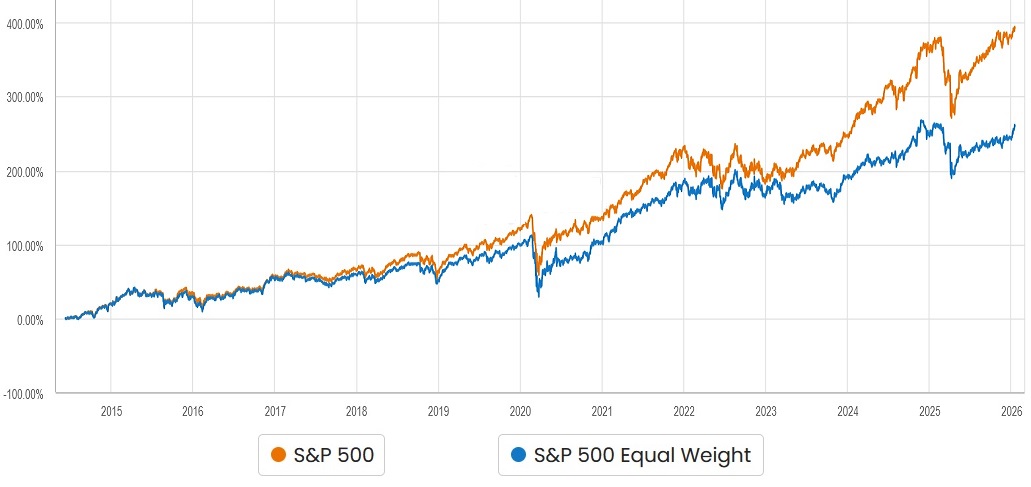
Over the years both funds performed similarly through 2023, as shown below. In 2024 and 2025, with the promise of Artificial Intelligence (AI) and the growth of companies like NVDIA, the equal-weight funds have lagged the tech-heavy conventional S&P500 funds, but I strongly believe that my recommended 50/50 strategy is the sound approach for diversification***, especially if the promise of AI falters and the value of tech-heavy firms drops precipitously, as some pundits have been cautioning in 2025 and 2026.
I've covered the performance of the S&P 500 stocks, which have delivered and average annual return of 11.84% from 1957 to 2024, but it's also worth mentioning again how these stocks have performed relative to those picked by so-called experts. Over the 10-year period ending in June 2019 92% of stock mutual funds managed by experts did worse than the S&P 500 index stocks, and this trend continues, with 85% of U.S. managed stock funds failing to beat the market in 2021 and 90 % of European funds unable to beat the market in the 10 years to 2022. In 2007 Warren Buffett, the 90-year-old Chairman and CEO of Berkshire Hathaway considered to be the most successful investor in history, waged a million dollars that over a 10-year period his choice of the S&P 500 index would beat the performance of top hedge funds typically seen as exclusive options for the ultra-rich -- he won handily (details here).
Both types of funds are offered by all mainline investment firms, so, when you're ready, go to one of these firms and get started (I like Fidelity's FXAIX for the traditional fund because it has the lowest management fee, there are offices in most cities, and they don't hassle you to try to push you to one of their managed funds with higher fees, and I like Invesco's RSP for the equal-weight fund because it has the lowest management fee).
__________________
* Other indexes are the Dow Jones (or simply The Dow, which consists of 30 stocks selected to represent the overall market and has an annual performance very similar to that of the S&P 500 Index) and the Nasdaq 100 (consisting of the 100 largest technology companies).** Size of a company is determined by its market capitalization, which is the cumulative value of all the shares in circulation, in other words, what it would cost for you to buy at current prices all the shares from all the shareholders of that company.
*** These funds invest in 500 companies, which would seem to meet the desired goal of diversification, but some view conventional S&P 500 index mutual funds as poorly diversified. In a May 2026 investor note the chief economist of Apollo Global Management said that the benchmark S&P 500 can no longer be viewed as broadly diversified because its top 10 holdings now account for roughly 34% of the index’s total weighting of 500 companies. Thus, my recommendation for a 50/50 split between conventional and equal-weight S&P 500 index mutual funds.