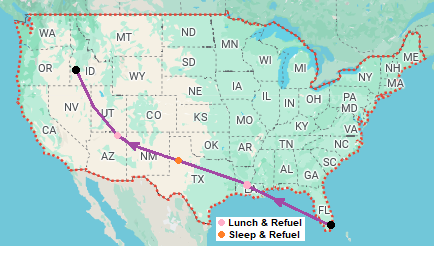
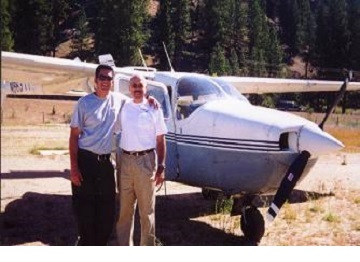
Over his 22 years as a pilot, Ernie had interesting stories to tell. By now you've read about his ditching in Bahamian waters when both engines quit. There was also the time he picked up his 2nd Skymaster (of 3) in Dayton, OH, and flew it solo to Miami in one day.But in terms of adventure, none compare to the stories from the week-long trip described below, from the southeast U.S. to the nortwest U.S.
The pictures seen here -- and the immensity of the Rocky Mountains -- are the backdrop of this May 2001 adventure. Small airplane and high mountains, plus a small, grass airstrip nestled in a deep valley at the destination. Oh, and Ernie only had 400 hours as a pilot, with no mountain flying experience!
With a student pilot he had recruited as a co-pilot for the trip, their first leg took them from Miami straight across the waters of the Gulf, with no land visible for three of the 5+ hour leg. The afternoon leg took them to west Texas for the night. The next morning they flew over gorgeous mesas, with the afternoon leg taken them over the Rocky Mountains, to Boise for the night. Early the next morning they took off for the 1-hour hop over the mountains to the small grass airstrip in Garden Valley, where Charlie was stationed as a forest firefighter.
They spent several days at Garden Valley, took Charlie up for a flight over the Idaho mountains and the Salmon river, and then made the return trip to Miami.
But that's just a summary, because they had several CRISES
during the trip, covered in the footnote*.
______________________
* These crises are in chronological order, from the start of the trip to the return home.The first hiccup happened on the first leg, over the Gulf from Miami to Baton Rouge, LA, when they strayed into one of the DO-NOT-ENTER Warning zones in the Gulf, where the military conducts live-fire excercises -- they flew out of the zone quickly, but this was Ernie's fault as the principal navigator.
Next hiccup was on Day 2, after spending the night in west Texas. After their stop for lunch and refuel in Arizona, the take-off was a harrowing ordeal. The temperature of about 100 degrees, the altitude of over 4300 feet, and the heavy weight of the aircraft after the tanks had been filled to the brim, led to a condition where the aircraft just couldn't take off. This condition, taught to pilots but unimportant in sea-level Florida, can be deadly. And again it was Ernie's fault not to have recognized it, since he had spent three months studying about mountain flying and receiving mountain-flying lessons from his flight instructor. Gil, the student pilot who was at the controls, accelerated down the runway, pulled the yoke back when the aircraft reached the NORMAL speed, the aircraft lifted off smoothly, started to climb, and then PLOP, slammed down on the runway. Realizing (finally) the problem, Ernie urged Gil to keep accelerating down the runway until the aircraft gathered more speed before lifting off, and then to stay within 20 feet of the runway to benefit from the ground-effect phenomenon which produces something akin to a bubble of supporting air. They did this successfully, with the aircraft finally lifting off the runway and continuing to gain speed -- and altitude -- as it flew close to the runway for over one thousand feet.
This was quite an unauspicious start to the most challenging of their five-hours-plus legs, because this was the leg that would cross the Rocky Mountains. They slowly gained altitude, retracted the landing gear and started the gradual climb. Shortly after reaching their cruising altitude of over 10,000 feet they encountered the mountains. Even at this altitude some of them towered above them, as the aircraft meandered between the snowy peaks in breathtakingly beautiful terrain. Soon they had left the high mountains behind, passed near Salt Lake City, and headed to their destination of Boise, ID, to spend the night.
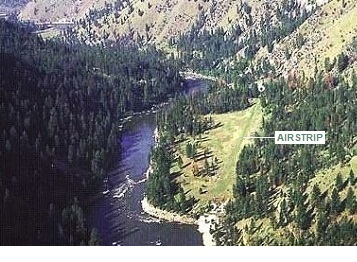
They took off from Boise the next morning, climbed over the mountains, and made the descent into Garden Valley. Nestled in a valley between peaks, the approach into the rural grass-strip "airport" is at a steep angle, in a spiraling motion. The center picture shown above depicts what the approach looks like. Despite three months of studies, Ernie's first mountain landing was quite poor and almost led to an accident. The steep angle of descent led to a too-fast approach and touch-down, and the poor braking on the wet morning grass from dew (which Ernie had read about but had forgotten) means that it took virtually the entire length of the landing strip, with the airplane coming to a stop only a few feet from the wood fence at the end of the airstrip. A stunned Charlie was there to greet them.
The return trip to Miami had several noteworthy events. First, about two minutes out of Garden Valley and early in the climb to get over the mountains, Ernie waited too long to switch tanks when one tank ran out of fuel and one engine stopped -- thankfully, the engine quickly recovered when Ernie switched tanks. Second, the selected course took them near the Grand Canyon, affording breathtaking sights. Third, landing back in west Texas they had a fierce crosswind and Ernie had to take the controls away from Gil to land without an accident. Fourth, they were stranded there for several days, while a huge tropical storm battered the East Texas - Louisiana area, finally flying around the northern part of the storm (through pretty crummy weather) into Jacksonville for the night and on to Miami the next day.
But the crises were far from over, considering what awaited Ernie at home, who had led his then-wife, Inita, to think he was flying commercial to visit Charlie. It turns out that Ernie's flight instructor had called the house on an unrelated matter, when Inita learned that Ernie had gone in his airplane. When Ernie got home he was promptly taken to the woodshed.